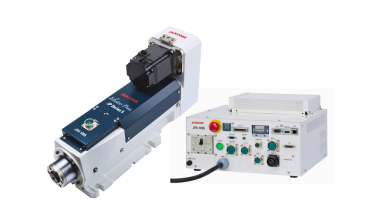
JP5 Series Unit-Type Standard Controller
A safety circuit is a circuit that reliably stops motion by cutting off the motor drive power to forcibly halt hazardous operation when the emergency stop switch is pressed.A safety circuit is a circuit designed to forcibly stop hazardous motion when the emergency stop (E‑stop) switch is pressed—by
cutting the motor drive power so the machine stops reliably.
For high-risk equipment such as electric presses, it is important not only that the machine “stops when you want it to,” but also that it operates on the safe side even if a failure occurs (i.e., the safety function is not lost).
In this article, we organize the fundamentals of safety-circuit operation, the concept of STO (Safe Torque Off) commonly used with servo motors, key precautions when resetting after an emergency stop, and the roles of redundancy and safety relays. We also touch on the benefits of adopting the JP5 Series unit-type standard controller, which has a built-in safety circuit.
Role of a Safety Circuit: “Cut Off Drive Power” During an Emergency Stop
The purpose of a safety circuit is simple: when the emergency stop switch is pressed, it puts the motor into a state where it cannot generate torque, stopping hazardous motion.
Especially for electric presses, where stopping certainty is critical, the design premise is to increase the reliability of the safety circuit.
For Electric Presses, “Redundancy” and “Fault Detection” Are Fundamental
For high-risk machines, to improve the reliability of the safety circuit, it is common to:
- Redundantly (dually) configure the circuit
- Use a safety relay capable of detecting faults
With redundancy, even if a single component fails, the design can make it less likely that the safety function is immediately lost.
With Servo Motors, Use STO (Safe Torque Off) to Shut Down
For servo motors, the servo drive’s STO (Safe Torque Off) function is used to cut off drive power.
STO is a safety function that prevents the servo motor from generating torque during an emergency stop, and it is widely used in safety-circuit design for servo systems.
Basic Safety-Circuit Operation (How to Read the Principle Diagram)
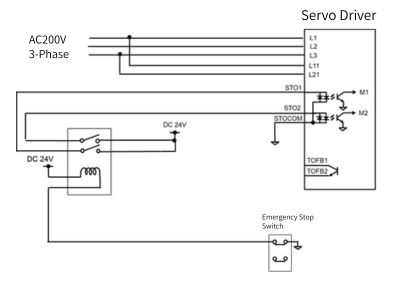
To illustrate the principle, consider a circuit that does not use redundancy (except for STO) and uses a simple relay rather than a safety relay.
- Press the emergency stop switch
- The contact opens and current to the relay coil stops
- The relay contact turns OFF
- The servo drive’s STO input is interrupted, and the servo motor drive power is shut off
This is the basic operation of a safety circuit.
Reset Design Matters: Releasing E-Stop Must Not Restore Power by Itself
When resetting from an emergency stop, you must proceed carefully while confirming that the hazard has been removed. The following points are especially important:
- Even if you release the emergency stop switch (twist to reset), that alone must not reset the system
- Restoring drive power must be done by an independent action
- Do not combine it with the start command
In other words, the design must prevent “E-stop reset = immediate restart.”
Example Reset Using a Self-Holding Circuit (Preventing Unintended Restart)
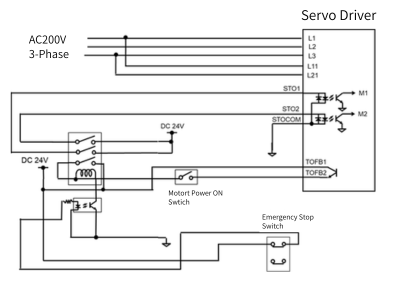
With this type of circuit, releasing the emergency stop switch does not turn drive power ON by itself.
Drive power turns ON only when the drive-power ON switch is pressed. Key points include:
- The relay coil is connected to DC 24 V through the drive-power ON switch and the servo drive’s TOFB output
- The TOFB output turns ON when the servo drive is operating normally and drive power is shut off
- If the servo drive is normal and the drive-power ON switch is pressed, current flows to the relay coil
Once the relay turns ON, the third contact keeps current flowing even after the switch is released (self-holding circuit).
In Practice, Safety Circuits Are Redundant (No Loss of Safety Function from a Single Fault)
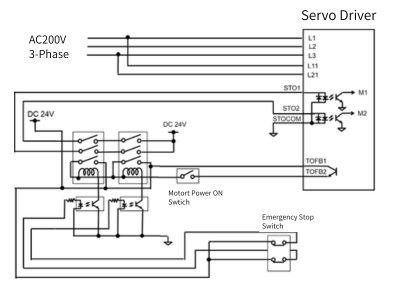
In actual safety circuits, the emergency stop switch and relays are configured redundantly.
With redundancy, a single component failure does not eliminate the safety function.
Using a Safety Relay Simplifies Design and Wiring
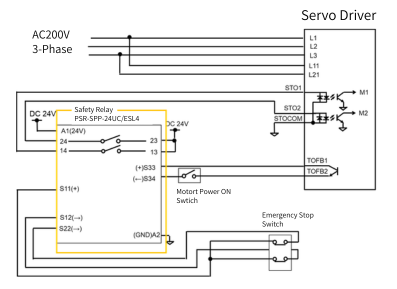
It is convenient to use a safety relay that provides the functions required for a safety circuit, including a redundant self-holding circuit.
This makes it easier to consolidate required functions and clarifies the design intent.
JP5 Series Standard Controller: Built-In Safety Circuit for Faster Commissioning
As shown above, a safety circuit must be designed not only to “stop,” but also to include redundancy, fault detection, and reset procedures—which tends to increase commissioning work and verification items.
Because the JP5 Series unit-type standard controller has a built-in safety circuit, it offers benefits such as:
- Reducing the burden on customers to prepare a separate safety circuit
- Reducing wiring and commissioning effort
- Enabling highly reliable operation with a safety circuit designed on the premise of maximizing JP5 Series performance
If you are unsure, for example:
- “We don’t know which configuration is appropriate for our safety requirements (emergency stop, reset procedure, interlocks, risk assessment).”
- “We want advice on whether the JP5 Series standard controller with built-in safety circuit or the compact controller is better for us.”
…it is best to consult us from the specification review stage.
After confirming your application requirements (pressing force, stroke, takt time, installation environment, required safety category, etc.), we will propose a configuration based on the JP5 Series. Please contact us via the inquiry form.