When people think of industrial robots, the first image that often comes to mind is the vertical articulated robot. This type is commonly seen on automotive production lines, performing tasks such as body painting and welding.
In contrast, desktop robots operate by placing the workpiece on an X-table and driving it back and forth. Due to this structure, they are not suitable for handling large workpieces.
They are also not ideal for applications involving picking workpieces from a moving belt conveyor.
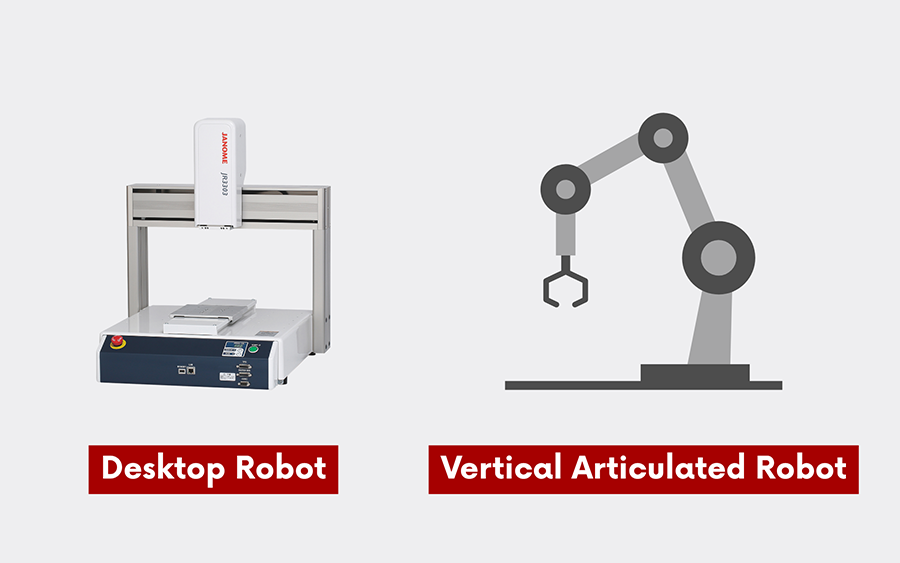
One of the key features of desktop robots istheir ability to perform high-precision path control.
Leveraging this capability, they are widely used in processes such as precision dispensing, soldering with a soldering iron, and PCB depaneling using the router cutting method.
Comparison Table – Desktop Robots vs. Vertical Articulated Robots
Both desktop and articulated robots have their own strengths and limitations.
To support your decision-making process before implementation, we have summarized the key features of each type in the comparison table below.
| Item | Desktop Robot | Articulated Robots |
|---|---|---|
| Applications | Precision dispensing, screw tightening, soldering, PCB depaneling (router method) | Automotive painting and welding, pick & place (P&P), assembly operations |
| Payload Capacity | Workpiece: 7kg, 15kg* Tool: 3.5kg、7kg* (*JANOME Desktop Robot JR4000Series, JR3000Series, 3-Axes Specification) |
Wide range from small to very large (e.g., models that lift entire car bodies) |
| Cost / Price Range | Relatively low cost | Generally high cost |
| Installation Requirements | Ready to use with minimal setup | Requires installation work and setup |
| Startup and Setup Time | In some cases, setup can be done in-house | Typically requires integration by a system integrator (SIer) |
| Required Technical Expertise | Simple tasks can be configured and operated without coding (via position & parameters) | Requires programming knowledge |
| Strengths / Specialization | Ideal for high-precision, small-scale operations with accurate path control | Multi-axis flexibility enables dynamic tool orientation and complex motion handling |
Note: The JR3000 series with a Heavy-Duty specification can handle workpieces up to 20 kg.
Understanding the unique strengths of both desktop and articulated robots is the first step toward achieving stable automation and improved productivity.
To learn more about selecting the optimal robot based on your specific processes, tasks, or installation environment, be sure to check out the related pages below.
For inquiries about product specifications or assistance with implementation, please feel free to contact us via our inquiry form.